

In the fast-paced world of digital marketing, attracting traffic to your website is only half the battle. The real challenge is converting that traffic into paying customers. This is where Conversion Rate Optimization (CRO) comes in. CRO is the process of improving the performance of your website to turn more visitors into customers, subscribers, or leads. Whether you run an e-commerce site, a SaaS business, or a blog, mastering CRO is crucial to increasing revenue without needing to spend more on advertising or traffic generation.
This in-depth guide will explain why CRO is essential, how it works, and actionable strategies you can implement to boost your website’s conversion rates.
1. What is Conversion Rate Optimization (CRO)?
Conversion Rate Optimization (CRO) is the practice of enhancing the user experience and functionality of a website to increase the percentage of visitors who complete a desired action. These actions could vary depending on the business goal, such as making a purchase, signing up for a newsletter, filling out a contact form, or downloading an e-book.
In simpler terms, CRO is about improving the ratio of visitors to customers. A high conversion rate means that your website is effective in persuading visitors to take actions that generate business value. For instance, if 100 people visit your e-commerce site and 5 of them make a purchase, your conversion rate is 5%. CRO aims to increase this percentage, thus driving more revenue from the same amount of traffic.
2. Why is Conversion Rate Optimization Important?
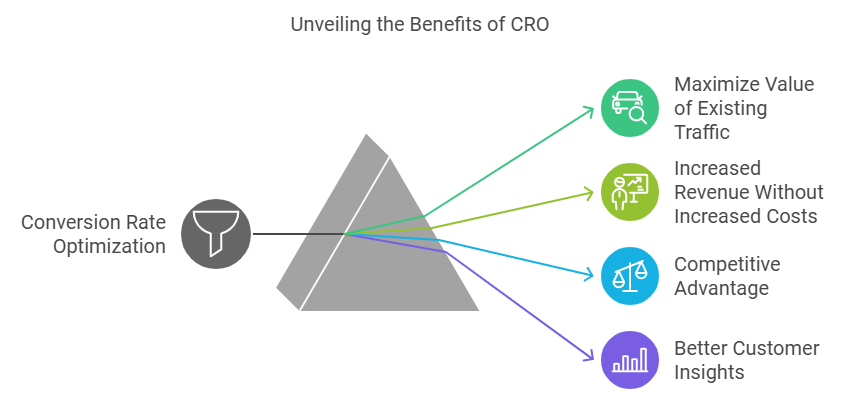
a. Maximize the Value of Existing Traffic
You may already be investing considerable time and money into attracting visitors to your website—whether through paid ads, SEO, or content marketing. But what if you could convert more of these visitors into paying customers without increasing your traffic? That’s exactly what CRO does.
By optimizing the user experience and enhancing website elements that encourage conversions, you make the most out of the visitors you already have. This means you’re improving the return on investment (ROI) from your existing marketing efforts.
b. Increased Revenue Without Increased Costs
Increasing your website’s conversion rate can lead to more revenue without the need for additional spending on marketing or advertising. In most cases, driving traffic to a website is expensive, especially through paid search ads or paid social media campaigns. But improving conversion rates ensures that you’re getting more out of your existing visitors. This not only saves you money on advertising costs but also results in increased profits.
c. Competitive Advantage
In today’s digital landscape, businesses that don’t prioritize conversion optimization risk falling behind their competitors. Your competitors are likely already improving their websites, testing new strategies, and optimizing their user experiences. By focusing on CRO, you stay ahead of the competition by improving your customer experience and getting the best results from your website traffic.
d. Better Customer Insights
CRO is not just about tweaking design elements to increase conversions; it’s about understanding your audience. By analyzing how users interact with your website, running A/B tests, and using data to inform decisions, CRO allows you to gain valuable insights into customer behavior. These insights can help shape marketing strategies, product offerings, and user experiences both on and off your site.
3. How Does Conversion Rate Optimization Work?
CRO works through a combination of research, testing, and continuous improvement. Here’s a breakdown of the steps involved:
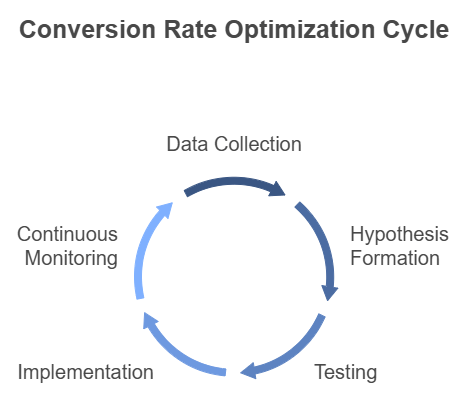
a. Data Collection and Analysis
Before making any changes, it’s crucial to gather data on how visitors are currently interacting with your website. There are several tools available that can help you track and analyze visitor behavior, such as:
- Google Analytics: Tracks page views, bounce rates, user demographics, and more.
- Heatmaps: Tools like Hotjar and Crazy Egg show where visitors click, scroll, and how they navigate your site.
- Session Recordings: Recording tools let you watch how users move around your site and interact with different elements.
- Surveys and Feedback: Directly asking visitors or customers about their experience can provide valuable insights into potential issues or frustrations they may face.
This data helps you identify problem areas on your site. For example, if users are bouncing off a particular landing page or abandoning their shopping carts, it’s a signal that something is wrong and needs to be addressed.
b. Hypothesis and Testing
Once you’ve gathered enough data, the next step is to form hypotheses about what could improve your conversion rate. For instance, if your website’s checkout process has a high abandonment rate, your hypothesis might be that the form is too long or confusing. You might propose simplifying the form to increase conversions.
Testing these hypotheses involves running A/B tests or split tests. In an A/B test, you create two versions of a webpage—Version A (the original) and Version B (the variation)—and show them to different segments of your visitors. This allows you to compare which version performs better in terms of conversions.
It’s essential to test one element at a time (such as a headline, image, call-to-action button, or color scheme) to isolate the impact of the change. Only through continuous testing and refining can you find the optimal combination of elements that maximize your conversion rate.
c. Implementation of Improvements
Once you identify which elements of the page drive higher conversions, you can implement the winning changes across the website. These improvements could include design changes, copywriting adjustments, or structural updates. Over time, as you continue to test and implement these changes, your conversion rate will gradually improve.
d. Continuous Monitoring and Iteration
CRO is not a one-time project; it’s an ongoing process. The digital landscape is always evolving, and so are your visitors’ behaviors. Therefore, it’s essential to continuously monitor your website’s performance and repeat the cycle of testing and optimization.
This cycle of gathering data, testing hypotheses, implementing changes, and refining strategies ensures that your website always aligns with the preferences and behaviors of your target audience.
4. Key Elements of CRO
There are several areas of your website that play a crucial role in influencing conversion rates. Here are the main elements to focus on when optimizing for conversions:
a. Website Design and User Experience
A well-designed website with an intuitive user experience (UX) is fundamental to CRO. If users find it difficult to navigate your site or the design is cluttered, they are likely to leave without taking any action.
- Responsive Design: With a growing number of people browsing from mobile devices, your website must be mobile-friendly. A responsive design ensures that your site looks and works great on any screen size, from smartphones to desktop computers.
- Clear Navigation: Your website should have easy-to-use navigation that allows users to find what they’re looking for without confusion.
- Fast Load Times: A slow website can drive users away. Make sure your website loads quickly to keep visitors engaged.
b. Call to Action (CTA)
Your CTA is the point where visitors convert. Whether it’s “Buy Now,” “Subscribe,” or “Get a Free Quote,” the CTA should be clear, compelling, and easy to find.
- Visibility: Make your CTA buttons large and visible.
- Compelling Copy: Use action-oriented language that tells visitors exactly what to do next, e.g., “Start Your Free Trial” instead of just “Submit.”
- Placement: Position your CTA strategically. It should be placed in prominent locations on your website, like near the top of the page, in the middle of your content, and at the end of your articles.
c. Trust and Credibility
Users are less likely to convert if they don’t trust your website. Establish trust by including elements that reassure visitors your site is legitimate and secure:
- Testimonials: Customer reviews and testimonials can provide social proof and build confidence.
- Trust Badges: For e-commerce sites, payment method icons (e.g., PayPal, credit card logos) and SSL security badges are essential for gaining trust.
- Clear Contact Information: Make sure your contact details are easily accessible, including a phone number, email address, or live chat option.
d. Social Proof
Social proof is a psychological phenomenon where people are influenced by the actions and opinions of others. Including social proof on your website can significantly increase conversions.
- User Reviews: Encourage customers to leave reviews and ratings.
- Case Studies: Highlight success stories or case studies showing how your product or service has helped others.
- Social Media Mentions: Displaying your social media feeds or user-generated content can also reinforce the value of your product or service.
e. Persuasive Copywriting
The language you use on your website plays a significant role in conversions. Your copy should be persuasive and focus on the benefits your visitors will receive. Avoid jargon and keep your messaging simple and to the point. Highlight your unique value propositions (UVPs) and emphasize what sets your product or service apart from competitors.
- Clear Headlines: Ensure your headlines are catchy and communicate your value right away.
- Benefit-Focused Copy: Focus on the customer’s needs and the benefits they’ll gain by converting.
5. Conversion Rate Optimization Strategies
Now that we’ve covered the essential elements, here are several CRO strategies that you can implement to improve your conversion rate:
a. A/B Testing and Multivariate Testing
As mentioned earlier, A/B testing is crucial to optimizing conversion rates. It allows you to test different versions of your landing pages, CTAs, and other key elements to see which one performs better. Once you identify the winning version, implement it to increase conversions.
b. Personalization
Personalization allows you to tailor the website experience to individual visitors. Using tools to show personalized offers based on a visitor’s browsing history or geographic location can significantly improve your conversion rates. Dynamic content, such as personalized greetings or product recommendations, can make users feel more engaged.
c. Simplify Forms
Forms are often the key step in many conversions, whether it’s a sign-up form, checkout form, or lead generation form. The easier it is for users to fill out a form, the higher your conversion rate will be. Limit the number of fields, make forms mobile-friendly, and ensure the process is simple and quick.
d. Use Urgency and Scarcity
Creating a sense of urgency or scarcity can prompt visitors to act quickly. Using tactics like countdown timers for limited-time offers or showing limited stock alerts can encourage visitors to make decisions faster.
e. Exit-Intent Popups
Exit-intent popups can be used to capture the attention of users who are about to leave your website. You can offer them a special discount, a free consultation, or a lead magnet to encourage them to convert before leaving.
Conclusion
In 2024, Conversion Rate Optimization is more important than ever. With businesses investing heavily in digital marketing, CRO provides the opportunity to maximize the ROI from your traffic. By focusing on the key elements of your website, testing, and continuously optimizing, you can increase the number of visitors who convert into customers. CRO isn’t just about tweaking small elements on your site—it’s about understanding your customers and offering them the best possible experience that aligns with their needs.
By implementing the right strategies and continuously refining your website, you can increase your conversion rates and drive growth for your business without necessarily increasing your traffic. CRO is a long-term investment in your business’s success, and in 2024, it’s essential for staying competitive in the digital space.

