

Pitching a digital marketing strategy to your boss is one of the most crucial tasks for a marketing professional. It’s not just about presenting a well-structured plan but also about convincing your boss that the proposed strategy will bring measurable benefits to the company. A successful pitch requires understanding both the big picture of digital marketing and the specific goals of your organization.
In this article, we’ll break down the step-by-step process of how to pitch your digital marketing strategy in a way that resonates with your boss, ensuring you cover key aspects of strategy formulation and make a convincing case for your plan.
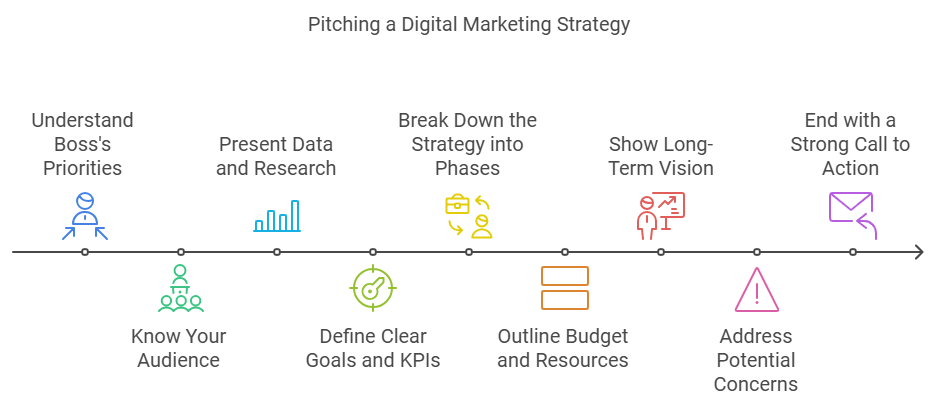
Step 1: Understand Your Boss’s Priorities and the Company’s Objectives
Before you even start drafting your pitch, it’s essential to understand the specific goals and priorities of your boss and the company. A solid pitch doesn’t just highlight what you plan to do but addresses how it aligns with the overarching business objectives.
- Discuss with Your Boss: If possible, have a conversation with your boss about their vision for the company. What are their primary concerns? What are they looking to achieve in the short term and long term? Are they focusing on growth, brand awareness, lead generation, or customer retention?
- Understand Company Goals: The digital marketing strategy you propose must align with the company’s goals. For example, if the company is expanding into new markets, your strategy might focus on international SEO and targeted digital ads in new regions.
By aligning your strategy with your boss’s priorities, you demonstrate a clear understanding of the company’s direction and how your plan will help reach those goals.
Step 2: Know Your Audience
When you’re pitching a digital marketing strategy, consider the audience you’re presenting to. Your boss may not be familiar with the technical details of digital marketing, so you’ll need to explain your strategy in a way that’s clear and understandable for them.
- Simplify Complex Ideas: Avoid jargon and overly complex terms. For instance, instead of saying “search engine optimization (SEO) optimization”, say “optimizing our website to show up higher in search results”.
- Focus on Outcomes: Your boss will care more about results than the process. They want to know how your strategy will improve the bottom line. Focus on how digital marketing will drive traffic, generate leads, and increase sales.
Understanding what your boss cares about allows you to tailor your pitch and focus on what will matter to them.
Step 3: Present Data and Research
One of the strongest ways to convince your boss is through data and research. Numbers back up your claims and show that you’ve thought through the proposal with real-world evidence. You want to use data to justify every aspect of your strategy.
- Show Market Trends: Use industry reports, market trends, or case studies to support your strategy. For instance, if you are proposing increased social media advertising, you can cite the growth of paid social advertising in the last few years and how it has benefited other similar companies.
- Competitor Analysis: Research competitors and present how they are utilizing digital marketing. Show your boss what’s working for them and how you can do it better or differently.
- Data-Driven Forecasts: Use analytics from past campaigns (if available) to forecast future results. For example, you might say, “Based on the 10% growth we saw in email open rates last quarter, we expect a 12% increase in conversion rates this time around.”
By presenting hard data, you add credibility to your strategy and show that it’s not just a shot in the dark but a well-researched plan.
Step 4: Define Clear Goals and KPIs
Digital marketing can be abstract at times, and to make your pitch compelling, you need to set clear, measurable goals that align with business objectives. Your boss wants to know what success looks like and how it will be measured.
- SMART Goals: Set specific, measurable, attainable, relevant, and time-bound goals. For example, instead of saying, “Increase website traffic,” say, “Increase organic website traffic by 20% in the next 6 months.”
- Key Performance Indicators (KPIs): Break down how you’ll measure success. KPIs could include metrics like website traffic, lead generation, conversion rates, click-through rates (CTR), or customer acquisition cost. Be specific about how each action you take ties into these KPIs.
By setting clear goals, you show that you have a clear direction and are ready to track your performance.
Step 5: Break Down the Strategy into Phases
A successful digital marketing strategy is rarely executed all at once. Presenting your strategy in phases helps to show a clear timeline, milestones, and how each phase builds upon the last.
- Phase 1: Research and Analysis – Explain that the first phase involves researching customer behavior, competitor strategies, and industry trends to refine the marketing approach.
- Phase 2: Implementation – Detail the actions that will be taken, such as content creation, SEO improvements, social media campaigns, or email marketing.
- Phase 3: Optimization and Adjustment – Mention how you’ll optimize campaigns based on performance metrics. Highlight the use of A/B testing, customer feedback, and analytics to fine-tune your strategy.
By breaking down the strategy into phases, you demonstrate that the plan is not overwhelming but manageable and flexible enough to adapt to changes.
Step 6: Outline the Budget and Resources Needed
For your boss to approve your digital marketing strategy, they need to know what resources are required. This includes the budget, tools, software, and team members.
- Budget Breakdown: Clearly break down the budget for each part of the strategy. This could include spending on paid ads, content creation, social media management, or marketing tools. If necessary, provide options with different budget levels and explain what can be achieved at each level.
- Team and Tools: Outline any tools or software you’ll need, such as Google Ads, HubSpot, or analytics tools. If you require additional team members or freelance support, mention this as well.
Being transparent about costs and resource requirements shows that you’ve considered the financial aspect of your strategy and ensures that you’re not blindsiding your boss with unexpected expenses.
Step 7: Show the Long-Term Vision
While it’s important to focus on short-term goals, your boss will also want to see the long-term vision for your digital marketing strategy. You should explain how your strategy will evolve and what results you expect over time.
- Scalability: Show how your strategy can grow with the company. If you’re starting with a smaller campaign, explain how it can expand as resources allow. For example, if you’re running a small Facebook ad campaign initially, explain how you’ll scale it up based on performance.
- Sustainability: Explain how your strategy is sustainable and adaptable. For instance, rather than relying solely on one digital channel, explain how you will integrate SEO, content marketing, social media, and email marketing to create a balanced, long-term approach.
The long-term vision helps your boss understand that this strategy isn’t just a one-time push but a foundation for ongoing growth.
Step 8: Address Potential Concerns
Your boss may have concerns or reservations about your strategy. It’s essential to be prepared to address these concerns directly and with confidence.
- Risk Management: Be ready to discuss potential risks and how you plan to manage them. For example, if you’re proposing a new channel that the company hasn’t used before, show how you will measure performance and optimize as you go.
- Previous Failures: If similar strategies have been tried in the past but didn’t succeed, be honest about it. Explain what went wrong, what you’ve learned from it, and how your approach will be different.
By anticipating concerns and addressing them upfront, you show your boss that you’ve thought through the strategy thoroughly.
Step 9: End with a Strong Call to Action
Finally, end your pitch with a clear call to action. What do you want your boss to do next? You could ask for approval to move forward, schedule another meeting to dive deeper, or request any additional resources needed to implement the strategy.
Conclusion
Pitching a digital marketing strategy to your boss requires a mix of preparation, research, and communication skills. It’s not just about presenting an idea but making a compelling case for why your strategy will help the company achieve its goals. By following the steps outlined in this article, you can structure your pitch in a way that addresses your boss’s concerns and demonstrates the value of your digital marketing strategy.

